AI earnings look strong, but the cash flow behind them tells a more cautionary tale.
Tom Dalrymple, Investment Analyst, Aubrey Capital Management
AI continues to dominate the headlines. Several questions have arisen around the sustainability of financing through debt markets, physical bottlenecks and monetisation. Estimates for next year’s hyperscaler capex continue to rise and now point to over $1.2tn of spending in 2027, with buyside expectations likely looking for even more. While it’s easy to pitch the case for the picks and shovels, we think it’s worth unpacking the dynamics that have driven the recent volatility within technology.
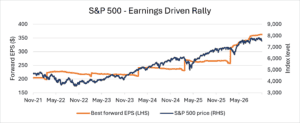
AI is often labelled a bubble, to which the response has been to point to earnings, which have climbed at exponential levels. The chart below illustrates this, and with the S&P 500 forward P/E sitting below its 10-year average many struggle to comprehend how any form of bubble could exist.
Source: Bloomberg
Why earnings look better than cash flow
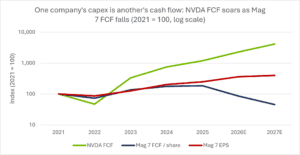
However, digging deeper into the mechanics behind this earnings growth can prove valuable, particularly capital spending and the way it is accounted for. To provide an example, when a hyperscaler goes and buys chips from Nvidia, it capitalises this cost and thus recognises the expense over several years through depreciation, with most hyperscalers assigning useful lives of 5-7 years. This helps to dampen the impact on earnings from the investment, whereas Nvidia recognises the revenue immediately upon delivery. This creates an earnings powerhouse, but the true cost shows up in the hyperscalers’ free cash flow.
Source: Bloomberg
The upshot is that as long as capex forecasts keep rising, earnings forecasts will follow. But after an unprecedented wave of investment, the same mechanism can just as easily reverse. Should capex stall, suppliers such as Nvidia would feel it immediately, while the hyperscalers would still be carrying years of depreciation on equipment already bought.
Where the cracks are showing
Thus far, capex has been consistently revised upwards, but the cracks are emerging. Rising borrowing costs have hit the debt-funded neoclouds hardest. CoreWeave’s bonds have sold off sharply, with yields approaching 15%, and the shares of peers such as Nebius have fallen alongside it. We expect these names to be the first to moderate their spending on the basis of balance sheet pressure, with capex expected to be more than double operating cash flow in 2027 for CoreWeave.
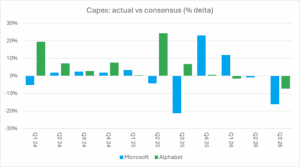
Alphabet, Amazon and Microsoft have far more bandwidth to raise debt and equity, but they face physical limits on labour and power. Microsoft acknowledged as much on its Q3 earnings call, citing delays at a GPU-as-a-service provider, a sign that the neoclouds are struggling to bring capacity online. The effect is now visible in quarterly capex. Microsoft’s came in 16% below consensus in Q3, and Alphabet’s has been in line with or below expectations for three quarters.
Source: Bloomberg
The market has already begun to adjust. Valuations across the AI picks and shovels have fallen sharply, marking a shift away from the dominant theme of the past three years, which we expect to persist in the coming months. The midterm elections add another layer of uncertainty. The initial rally, led by financials, healthcare and consumer stocks, left AI-linked shares behind, and the broad sell-off that followed hit them hardest, as investors weighed the prospect of tighter restrictions on new data-centre projects.
What this means for investors
Taken together, this points to a market that has started to separate companies whose earnings are backed by cash from those whose earnings depend on someone else’s capital spending. That distinction sits at the heart of how we invest, and it is one that a passive allocation to the index cannot make.
The past few months have been uncomfortable for growth investors, ourselves included. But as leadership broadens beyond the handful of stocks that have dominated indices for three years, we believe the case for a concentrated portfolio of cash-generative businesses, each chosen on its own merits, grows stronger.